From the Journal
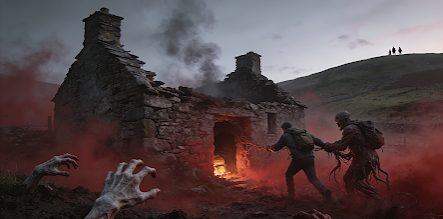
The Hike Along the Border.
The afternoon sun hung low, casting long, golden shadows across the rolling hills that mark the divide between Wales and England. For Tom, Dave, and Elias, the hike had been perfect so far—crisp air, sweeping views, and easy conversation as they followed the ancient footpath. They had covered nearly six miles, their legs steady, their spirits high, when the landscape shifted. The open moorland gave way to overgrown hedgerows and rough pasture, and there, tucked into a hollow between two slopes, stood the ruins. It was the skeleton of an old farmhouse, stone walls half-collapsed, roof long gone, timber beams rotting and blackened by weather. Around it lay the remains of outbuildings and what must have once been a yard, now choked with brambles and tall, yellowed grass. It looked as though it had been abandoned for decades, maybe even a century or more—silent, still, and reclaimed by the land. And yet, as they drew closer, Elias stopped short, lifting his head like a blood hound catching a scent. "Do you smell that?" he asked, his voice dropping. Tom and Dave paused. At first, there was only the sharp tang of damp earth and wild gorse. Then, drifting on the faint breeze, came something else: warm, yeasty, sweet and rich. Fresh bread, baking in an oven, thick and comforting and unmistakable. It was so vivid Tom could almost picture the crust turning golden, steam curling from a hot loaf. "That’s… impossible," Dave said, stepping forward, eyes scanning the hillside. "There’s no house for miles. Nothing but us and the moor." Then they heard it. A man’s voice, deep and rough, calling out from somewhere beyond the ruins. “Gethin! Gethin, where’ve you got to? The beasts are loose again!” The words carried clearly, bouncing off the stone walls, followed by the low murmur of a second voice, too quiet to make out, like a reply muttered from further away. The three men froze. The sound was so real, so present, that they immediately turned to search the fields, scanning every ridge, every stand of trees, every dip in the land. There was no smoke rising from any chimney, no track leading to or from the place, no sign of a living soul anywhere. Just empty fields, stretching away to the hazy horizon. "Must be an echo," Tom said, though he didn’t believe it. "Wind carrying sound from somewhere else." "From where?" Elias snapped, already edging toward the broken doorway of the farmhouse. "There is nowhere else." Curiosity warring with unease, they moved toward the ruins. The smell of bread grew stronger, thick enough to taste, sweet and heavy, cloying at the back of the throat. The voices came again—shouts, laughter, the clatter of pails, the low moo of a cow—but still, there was nothing to see. The farm lay dead and desolate, crumbling stone and weeds, silence pressing in hard as soon as the sounds faded. "Let’s just look inside," Dave said, pulling his hiking knife from his belt, more out of habit than intent. "Five minutes, then we move on. Something’s not right here." They stepped over the threshold, boots crunching on shattered slate and rotting wood. The main room was gutted, walls stained dark by rain and time, floorboards long since rotted away to reveal the earth beneath. In the center, where a hearth must have been, lay a pile of blackened stones and ash. That was when the air changed. The warmth that had carried the smell of bread vanished instantly, replaced by a cold so deep it felt like it was seeping into their bones. The light dimmed, as if a cloud had swallowed the sun, though when Tom glanced out the empty window frame, the sky was still bright and clear. And then the voices returned—but different now. No longer calls or laughter. Screams. Raw, guttural, tearing sounds that seemed to come from all around them and from nowhere at once. The smell of bread curdled, turning sharp and metallic, thick with copper and sweat. "Back out! Now!" Tom yelled, grabbing Elias by the shoulder. Elias didn’t move. He was staring at the hearth, eyes wide, mouth hanging open. From the dark space beneath the stone lintel, something was rising—not smoke, not shadow, but a thick, viscous red mist that pooled on the ground and began to spread outward. Within it, shapes were forming: twisted, elongated figures, their outlines blurred, limbs too long, faces featureless save for wide, gaping mouths. Before anyone could move, a hand shot out from the mist—pale, skin flayed raw, nails black and cracked—and wrapped around Elias’s ankle. He screamed as he was dragged forward, his legs sliding uselessly over the mud and debris. Dave lunged to grab him, but as he reached down, another hand burst from the earth, then another, then dozens—torn flesh, splintered bone, sinew glistening—clawing upward, pulling themselves free from the soil as if they had been buried just inches below the surface all this time. One seized Dave’s wrist, and he cried out as teeth—rows of jagged, yellowed teeth—sank into his forearm, tearing through fabric and skin, ripping away chunks of meat. The smell of fresh bread was gone completely now, replaced by the stench of blood, offal, and burnt grain. The air filled with wet, tearing sounds, the crunch of bone, the sickening squelch of flesh giving way. Tom stumbled backward, tripping over a fallen beam, scrambling to his feet as he watched his friends being pulled down. Elias was still screaming, though his voice was already thinning, his legs disappearing into the red mist as more things swarmed over him, tearing and rending, their movements frantic, hungry, relentless. Dave swung his knife wildly, slashing at pale, flayed faces, but it made no difference—there were too many, and they were rising from every crack in the floor, every gap in the walls, surging from the fields outside, from the trees, from the very air itself. He didn’t wait to see more. Tom turned and ran, bursting out through the empty doorway, sprinting across the overgrown yard, boots slipping in mud and blood that he hadn’t noticed was there before. Behind him, the sounds were terrible—wet, heavy, rhythmic, like butchery in full swing. The voices were back too, loud and triumphant: “Gethin! Gethin, bring the next one in! There’s plenty more to feed the hunger!” He didn’t look back. He ran until his lungs burned, until his legs gave out, until he was miles away from the ruins, back on the open moor where the air was clean and cold and empty. When he finally stopped, gasping for breath, shaking so hard he could barely stand, he looked back toward the border hills. Far off, faint but unmistakable, he caught it again—the sweet, warm scent of fresh bread, drifting on the wind. And carried with it, the distant call of a farmer, waiting for his hand to come and help with the harvest. Somewhere along that old border path, the farm was still working. And it was hungry.
External Link → ← Return to All Blogs